
Bill to protect Nebraska physicians recommending medical cannabis unopposed at hearing
Majority of HHS Committee says it favors advancing bill to full Legislature
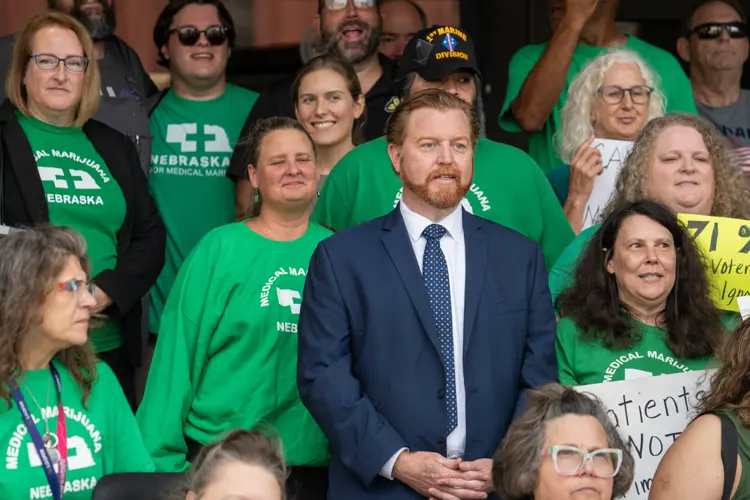
State Sen. John Cavanaugh of Omaha, center, joins advocates for medical cannabis at the Nebraska State Office Building in Lincoln, Nebraska, ahead of a public hearing on a regulatory system for the new medicine approved by voters in November 2024. To Cavanaugh's left is Shannon Coryell of Omaha, a medical cannabis patient who has sought a physician's recommendation to get the medicine in a different state. Oct. 15, 2025. (Zach Wendling/Nebraska Examiner)
By Zach Wendling, Nebraska Examiner
LINCOLN, Neb. — A majority of Nebraska’s Health and Human Services Committee appears open to a legislative proposal to explicitly protect physicians who recommend medical cannabis to patients.
The seven-member committee is considering Legislative Bill 933 from State Sen. John Cavanaugh of Omaha. It would grant recommending medical practitioners immunity from civil, criminal or disciplinary action solely for stating that, in the provider’s professional opinion, a patient is likely to receive therapeutic benefit or symptom relief from using cannabis for a medical condition.
At least four committee members told the Nebraska Examiner they were in favor of the bill by Friday afternoon.
“It’s not a new or novel concept, and it’s not uncharted territory,” said Crista Eggers of Nebraskans for Medical Marijuana, the group that led two 2024 ballot measures on medical cannabis.
Of the nearly 20 other states with only medical cannabis programs and not recreational marijuana, each has explicit protections for recommending providers, according to data from Eggers and Cavanaugh.
Five Nebraskans who are caregivers or patients testified in favor of the bill, but no providers did, which Eggers said demonstrates fear around the topic. No one testified in opposition to the bill.
‘Established relationship’
Nebraska voters in November 2024 overwhelmingly legalized possession of up to 5 ounces of medical cannabis with any health care practitioner’s recommendation. The law took effect Dec. 12, 2024. Patients or caregivers following the state law are immune from state or local criminal penalties. Voters separately created the regulatory Nebraska Medical Cannabis Commission, which will eventually license in-state dispensaries, allowing legal sales of the drug in the Cornhusker State.
But over the past 15 months, lawmakers and advocates say they are not aware of any in-state providers who have recommended medical cannabis.
Nebraska, too, was left off congressional protections for states with medical cannabis programs, typically a noncontroversial addition to a federal spending bill that protects 47 other states with at least some form of medical cannabis laws, but the latest update in January did not include Nebraska.
Amid uncertainty, some patients said they have gone to other states for recommendations and medicine.
Shannon Coryell of Omaha, who suffered a traumatic brain injury and brain rupture that left her partially paralyzed, and Lia Post of Springfield, who has complex regional pain syndrome, are two such patients. Both testified in favor of LB 933, and both campaigned for the new laws.
Coryell said she didn’t leave for a specialist but after in-state providers were “unwilling” to discuss the matter. As she gets older, she said she wants a smaller pool of doctors for her care.
“While in theory I have my bases covered at the moment, it would be nice to be able to continue with a doctor I have an established relationship with and who continues following my care throughout my life,” Coryell said Thursday.
‘Spirit of seeking consensus’
Cavanaugh said he was bringing the bill in the “spirit of seeking consensus” and as a narrow way to help Nebraskans who need medical cannabis and so they have safe access.
The ballot measure did not include the provider protections, partly over concern that doing so would raise another “subject” in violation of the Nebraska Constitution’s “single subject” rule, Cavanaugh said.
Advocates worried about the need to keep things narrowed after a more comprehensive medical cannabis measure had qualified for the ballot in 2020 as a single constitutional amendment, but the Nebraska Supreme Court ruled it covered more than one subject and disqualified the proposal.
A subsequent effort separating the measures to legalize and regulate the drug fell short in 2022 but passed overwhelmingly in 2024.
Cavanaugh’s bill borrows language from LB 677 last year from State Sen. Ben Hansen of Blair. Hansen’s more expansive medical cannabis bill sought to give more structure to the Medical Cannabis Commission, including funding. It failed 23-22. The bill would have needed 33 votes to alter a state law passed by ballot measure.
Cavanaugh is a Democrat and Hansen is a Republican. The Legislature is officially nonpartisan.
Some proposed changes to the commission, including tools to fund its work, are being tackled in the now-largely noncontroversial LB 1235, after the General Affairs Committee removed broader language involving patients and caregivers.
AG opposed earlier bill
Nebraska Attorney General Mike Hilgers, a Republican, led opposition to Hansen’s 2025 bill. At the time, he took particular issue with the proposed practitioner protections. At a May news event where Hilgers rolled out dozens of law enforcement officials against Hansen’s legislation, Hilgers said his office plays an “enormously critical role” in ensuring health professionals follow their license.
Should a health care practitioner recommend cannabis to a pregnant woman, whose pregnancy ends in miscarriage or fetal development disability, or someone with a history of mental health challenges commits suicide or murder, as examples, Hilgers said the state needs leeway to act.
“All health licensure is at risk of revocation, except in this case, if this bill were passed,” Hilgers said.
Neither Hilgers’ office nor the Nebraska Department of Health and Human Services, which also opposed LB 677, formally opposed Cavanaugh’s bill, in person or in online letters.
Risk-averse profession
Twenty-five online letters were submitted by Thursday morning, of which 24 were in favor.
The one comment opposing the bill came from Laurie Kohmetscher of Fairfield, who argued the legislation was “too vague” and could offer a “free pass from responsibility.”
At the hearing, Cavanaugh offered an amendment mirroring language from Oklahoma that a provider who fails to properly evaluate a patient’s medical condition or who otherwise violates the physician-patient standard of care would not be protected from civil or disciplinary action.
State Sen. Beau Ballard of Lincoln, who used to work for Hilgers, asked if there were similar state immunity protections for physicians who oversee other medicines, such as opioids.
Cavanaugh and Hansen, a chiropractor, said doctors are inherently “risk averse,” and Hansen read language from the National Association of Attorneys General stating doctors have broad, legally protected authority to prescribe medications for approved and off-label uses based on their professional judgment. In those cases, the protections still aren’t “absolute.”
“It seems to me like this language almost mirrors that kind of approach,” Hansen said.
‘Change our children’s lives’
Dominic Gillen of Bellevue is another longtime proponent of medical cannabis for his son Will, who has Lennox-Gastaut syndrome, a severe, rare form of early-childhood epilepsy that will stay with Will Gillen his entire life.
Dominic Gillen said Will Gillen faces three or four types of seizures, so treating one type affects the others. Will Gillen is nonverbal and is now in his 20s.
Will Gillen is on three “black box” drugs, medications the U.S. Food and Drug Administration has approved with a warning of liver damage, severe psychiatric effects, addiction or death.
“No one from the Attorney General’s Office calls to question those prescriptions. No one steps in to say, ‘Doctor, are you sure about this?’” Dominic Gillen testified.
The father said the issue wasn’t about politics but medical freedom and allowing doctors to keep both eyes on their patient, not one looking at the AG’s Office.
Answering a question from State Sen. Glen Meyer of Pender, Dominic Gillen said he can’t tell for certainty that cannabis would help, and in 12 years of advocacy, he said he’s never called cannabis a “magic bullet.” However, the hope is to alleviate some symptoms and improve Will Gillen’s quality of life.
Eggers similarly has been advocating for medical cannabis in part to help her 11-year-old son, Colton, who has severe seizures. Since 2017, she has said she knows of 41 advocates who have died while waiting for access to the proposed medicine.
“This has the ability to change our children’s lives for the better,” Eggers testified.
Committee member positions
Hansen and State Sens. John Fredrickson of Omaha and Dan Quick of Grand Island, who supported LB 677, confirmed they are in favor of Cavanaugh’s narrow bill. Quick said it’s important for providers to act without fear of repercussions.
A fourth vote appears likely from State Sen. Merv Riepe of Ralston, a former hospital administrator who said he’s in favor as long as the program stays medical and doesn’t veer into recreational marijuana or smoking. He did not take a position on LB 677 last year.
Ballard said he needed more information and was undecided, as did Meyer. Meyer was one of the eight Republicans who supported Hansen’s LB 677 last year.
Meyer said he can see where Cavanaugh is coming from, but without the ability to obtain medical cannabis, he had some concern the bill would put the “cart before the horse.” At the hearing, he asked whether a doctor could recommend cannabis for something like a sore elbow.
Cavanaugh said the standard of care is balancing risk with fear of possible legal or professional repercussions getting in the way.
State Sen. Brian Hardin of Gering, committee chair, said he didn’t know where he was on the bill and that his committee would make some decisions on LB 933 in the “early part” of this week.
Cavanaugh has selected LB 933 as his “priority” for the year, meaning if advanced from committee, it joins other priority bills subject to scheduling by Speaker John Arch of La Vista. Arch, a former HHS Committee chair, took no position on LB 677 last year.
The HHS Committee is scheduled to meet Tuesday morning to decide whether to advance LB 933 to the full Legislature.
Nebraska Examiner is part of States Newsroom, a network of news bureaus supported by grants and a coalition of donors as a 501c(3) public charity. Nebraska Examiner maintains editorial independence. Follow Nebraska Examiner on Facebook and Twitter.